







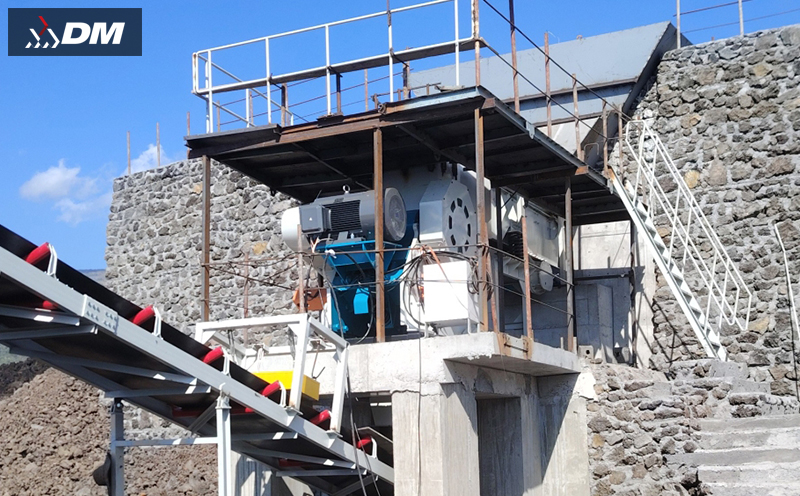
1. The "Dual Test" of Pakistan's Working Conditions: How Heat and Dust Hinder Equipment Operation
Most parts of Pakistan have a tropical desert climate. The average daily temperature in summer (April-August) exceeds 38℃, and the afternoon temperature in some mining areas can reach 45-50℃, with high temperatures acting as an "invisible furnace" continuously baking the equipment; at the same time, the dust concentration at local limestone and granite mining sites often exceeds 100mg/m³, and the dust generated during crushing operations, mixed with ore particles, erodes equipment components like "sandpaper". The superposition of these two harsh conditions traps traditional crushers in a dilemma of "high failure rate and low availability": high temperatures trigger frequent overheat protection of motors (2-3 shutdowns per day, 30 minutes each time), and bearings wear accelerated due to grease failure (needing replacement once a month); dust invades the hydraulic system, causing valve blockage, and hydraulic failures account for 40% of total failures; moreover, due to poor equipment sealing, dust accumulation in the electrical cabinet causes short circuits, requiring 1-2 days for a single maintenance, resulting in a monthly availability rate of less than 80%. For Pakistani mining enterprises and quarries, equipment that "fears high temperatures and dust accumulation" not only interrupts production but also increases maintenance costs. A crusher that "resists heat, prevents dust, and minimizes shutdowns" is the key to breaking through working condition limitations and ensuring continuous production.
2. Strong Sealing Design: Building a "Isolation Barrier" Against Dust
Targeting Pakistan's high-dust environment, the equipment is designed from three aspects—"full-dimensional sealing, active dust prevention, and easy cleaning"—to minimize dust intrusion to the industry's lowest level and significantly reduce dust-induced failures.
1. Multi-Level Sealing Structure: 90% Reduction in Dust Intrusion
The equipment body adopts an "integrated sealing cover + segmented sealing interface" design: the sealing cover is made of 2mm-thick cold-rolled steel plates, formed by CNC bending and fully welded, with no splicing gaps; at the joints with the feed port and discharge port, a double seal of "nitrile rubber seal ring + metal dust retainer" is used, and the compression amount of the seal ring is controlled at 3mm to ensure tight fitting without gaps. Key moving parts (such as the jaw crusher's swing jaw shaft and cone crusher's main shaft) adopt a combination of "labyrinth seal + high-pressure grease seal"—the labyrinth structure blocks dust through 5 annular grooves, and high-pressure grease forms an "oil film barrier" in the sealing cavity. Even in an environment with a dust concentration of 150mg/m³, the dust accumulation in the bearing box is still controlled within 5mg, and the bearing service life is extended to 8,000 hours (about 4,000 hours for traditional equipment). The electrical cabinet adopts an IP67 sealing design, with foam sealing strips added at the joint between the cabinet door and the cabinet body, and the vent is equipped with a HEPA high-efficiency filter (filtration accuracy 0.3μm), ensuring that electrical components in the cabinet are not eroded by dust, reducing electrical failures by 85%.
2. Active Dust Prevention System: Reducing Dust Contact at the Source
A "three-level dust prevention" is set at the front end of the crushing process: a high-pressure atomization dust removal device is installed above the feed port, which atomizes water into 3-5μm fine mist through a 0.4MPa high-pressure water pump, combining with the raised dust for sedimentation, achieving a dust removal efficiency of 92%; an inclined dust guide plate is installed inside the crushing chamber to guide dust to be discharged from the discharge port together with the crushed ore, avoiding dust retention and accumulation in the chamber; a small induced draft fan is installed on the top of the sealing cover to form a micro-negative pressure environment, sucking a small amount of residual dust into an external bag filter, ensuring that the dust concentration around the equipment is controlled below 10mg/m³, far lower than Pakistan's industrial hygiene standard (50mg/m³). In addition, a closed conveyor belt is equipped below the discharge port, with rubber skirts added on both sides of the conveyor belt to further prevent dust overflow during ore transportation.
3. Easy-Clean Design: Reducing Dust Maintenance Working Hours
A quick-opening maintenance door is set on the side of the sealing cover, which is opened with a hydraulic support rod and can be operated by one person. After opening, the residual dust inside the cover can be directly cleaned; a detachable dust-proof plate is set at the bottom of the crushing chamber, which can be quickly removed to clean the dust at the bottom of the chamber without disassembling the entire machine; the electrical cabinet filter adopts a "snap-on installation" design, which can be replaced without tools in 1 minute, avoiding the problem that traditional bolt-fixed filters are difficult to disassemble due to dust accumulation. In practical application, the weekly dust cleaning time of the equipment is only 1.5 hours, 70% less than that of traditional equipment.
3. Efficient Overheat Prevention Technology: Taming the "Invisible Killer" of High Temperature
Targeting the extreme high temperatures in Pakistan's summer, the equipment ensures that the temperature of core components is stable within a safe range through three technologies—"active heat dissipation, thermal protection, and intelligent temperature control"—avoiding high-temperature shutdowns.
1. Multi-Dimensional Heat Dissipation System: Core Component Temperature Controlled Below 65℃
The motor adopts a combination of "forced air cooling + heat pipe heat dissipation": the motor housing is equipped with spiral heat sinks (heat dissipation area 50% larger than traditional motors), combined with a high-power axial fan (air volume 2000m³/h) to forcefully dissipate motor heat; 3 heat pipes are embedded inside the motor to quickly conduct the heat of the windings to the housing, and the motor temperature rise is controlled within 40K (when the ambient temperature is 50℃, the motor temperature ≤90℃, far below the rated upper limit of 120℃). The hydraulic system is equipped with a "dual-circuit cooler": the main circuit uses a plate heat exchanger (heat dissipation area 1.2㎡), and the auxiliary circuit uses an air cooler. The dual systems work together, and even in a 50℃ environment, the hydraulic oil temperature can still be stabilized below 55℃ (the optimal working temperature of hydraulic oil is 30-60℃), avoiding hydraulic valve jamming caused by excessive oil temperature. The bearing housing adopts a "circulating oil lubrication + oil cooling" design: the lubricating oil is circulated through an external oil pump, cooled by a cooler, and then injected into the bearing housing, controlling the bearing temperature within 65℃, 25℃ lower than the temperature of traditional grease-lubricated bearings.
2. Thermal Protection Treatment: Isolating External High-Temperature Invasion
The outer surface of the equipment body is coated with reflective heat-insulating paint (reflectivity up to 85%), which can reflect 60% of solar radiant heat, avoiding the increase of internal temperature due to heat absorption by the body; a sunshade is installed on the top of the electrical cabinet, made of FRP (fiberglass-reinforced plastic) material (thermal conductivity 0.15W/(m·K)), combined with a small air conditioner (cooling capacity 500W) in the cabinet, ensuring that the temperature inside the cabinet ≤40℃, avoiding the aging of electrical components due to high temperature. For equipment operating in the open air, a "detachable sunshade cover" can also be optionally equipped to further isolate direct sunlight, reducing the internal temperature of the equipment by 8-10℃.
3. Intelligent Temperature Control System: Early Warning of High-Temperature Risks
The equipment is equipped with multi-point temperature sensors to real-time monitor the temperature data of the motor windings, hydraulic oil, and bearings, and the data is visually displayed on the touch screen of the control cabinet; when the temperature is close to the safety threshold (e.g., motor temperature reaches 85℃, hydraulic oil temperature reaches 58℃), the system automatically increases the power of the heat dissipation system (e.g., increasing fan speed, turning on the backup cooler); if the temperature continues to rise to the warning value (e.g., motor temperature reaches 95℃), an acousto-optic alarm is triggered, and the operator is prompted to take emergency measures (e.g., reducing feed volume, temporary shutdown for heat dissipation). In the 2024 Pakistan summer test, the equipment operated continuously for 12 hours in a 48℃ environment, and the temperature of core components did not exceed the safety threshold, with no high-temperature shutdowns.
4. Ultra-High Availability Guarantee: Full-Lifecycle Support from Design to Operation and Maintenance
Relying on strong sealing and overheat prevention design, the equipment's monthly availability rate in Pakistan's harsh working conditions is stably above 96%. At the same time, "durable structure and intelligent operation and maintenance" further reduce the risk of failures:
- Durable Structure: The frame is integrally welded with Q355B high-strength steel, and internal stress is eliminated through annealing treatment, improving the deformation resistance by 40% in high-temperature environments; wear-resistant parts (jaw plates, hammer heads) adopt the "high manganese steel + tungsten carbide composite layer" process, with a service life extended by 80% in high-temperature and dusty environments, requiring replacement only once a month, reducing the number of shutdown maintenance.
- Intelligent Fault Diagnosis: The equipment is equipped with a PLC intelligent control system, which can automatically monitor the sealing status (e.g., dust intrusion caused by seal ring wear) and the operation of the heat dissipation system (e.g., fan failure). After detecting an abnormality, it immediately alarms and indicates the fault location, shortening the average fault handling time to 1.2 hours.
- Local Operation and Maintenance Support: Spare parts warehouses are established in Karachi and Lahore, Pakistan, storing wearing parts such as seals, cooling fans, and temperature sensors, which can be delivered to mining areas within 24 hours; at the same time, 15 local technicians are trained to provide on-site installation and maintenance services, avoiding long-term shutdowns caused by waiting for overseas technical support.
5. Conclusion: Empowering Pakistan to Break Through Working Condition Limitations with Hardcore Quality
Under Pakistan's harsh working conditions of heat and dust, the "durability" of the crusher directly determines the continuity of production and the level of income. This crusher with strong sealing and overheat prevention reduces the equipment failure rate to below 3% and increases the monthly availability rate to above 96% through targeted dust isolation and high-temperature control design, completely solving the pain point of traditional equipment "fearing heat and dust". Whether it is continuous crushing in limestone mines or aggregate production in granite quarries, it can ensure uninterrupted production with stable performance, helping Pakistani users break through working condition limitations and achieve efficient operation of "investment equals output", injecting reliable impetus into the development of local mining and infrastructure industries.
If you would like to get help immediately, you can also fill your requirements on the following form, we will contact you on the right time.


Get In Touch