







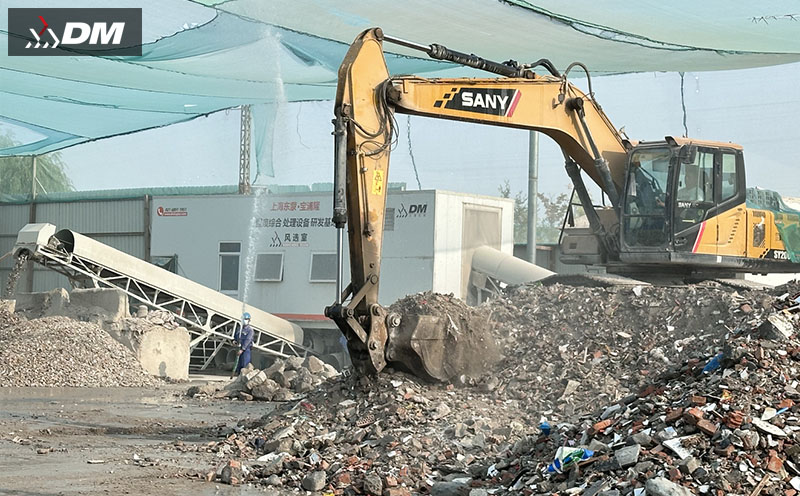
As global urbanization and industrialization accelerate, waste generation has reached unprecedented levels—construction and demolition (C&D) waste, industrial solid waste, and municipal solid waste (MSW) pose significant environmental challenges while hiding enormous resource value. Traditional waste recycling methods suffer from low efficiency, poor sorting accuracy, high energy consumption, and difficulty in scaling. To address these pain points, DongMeng has developed a suite of "smarter" waste recycling solutions, integrating artificial intelligence (AI), the Internet of Things (IoT), and modular technology. These solutions transform waste recycling from a labor-intensive, low-value process into an intelligent, high-efficiency, and high-yield operation—unlocking the full potential of waste as a "urban mine" and empowering the global circular economy.
Core Pillars of Smarter Waste Recycling: Intelligence, Efficiency & Sustainability
DongMeng’s smarter waste recycling solutions are built on three core pillars, addressing the fundamental limitations of traditional recycling and delivering comprehensive value for clients.
1. AI-Powered Intelligent Sorting: Precision Beyond Human Capability
Sorting is the bottleneck of waste recycling—traditional manual sorting is slow, error-prone, and unsafe, while conventional mechanical sorting lacks flexibility for complex waste streams. DongMeng’s AI visual sorting system revolutionizes this process with unmatched precision and speed.
Equipped with high-resolution cameras, near-infrared (NIR) sensors, and advanced AI algorithms, the system can identify and classify up to 12 types of materials (concrete, steel, plastic, wood, glass, asphalt, etc.) in mixed waste with an accuracy rate of ≥99%. The AI model continuously learns from data, adapting to variations in waste composition (e.g., different types of construction waste or industrial by-products). The sorting speed reaches 3,000 pieces per hour, 3-5 times faster than manual sorting. Complementary magnetic separators and eddy current separators extract ferrous and non-ferrous metals with a recovery rate of ≥98%, ensuring no valuable resources are wasted.
For example, in a construction waste recycling plant in China, DongMeng’s AI sorting system processed 500 tons of mixed C&D waste daily, separating concrete aggregates, steel reinforcement, and plastic impurities with 99.2% accuracy. The purified recycled aggregates met national high-grade concrete standards, increasing the plant’s revenue by 30% compared to traditional sorting methods.
2. IoT-Connected Smart Crushing & Processing: Data-Driven Optimization
Smarter recycling goes beyond sorting—it requires real-time control and optimization of the entire processing chain. DongMeng’s IoT-connected crushing and screening system enables data-driven decision-making, maximizing efficiency and product quality.
Key components (crushers, screens, conveyors) are fitted with IoT sensors that monitor operating parameters in real time: temperature, vibration, load, output, and particle size. This data is transmitted to a centralized cloud platform, accessible via mobile or desktop terminals. The system automatically adjusts feeding speed, crushing cavity settings, and screen frequency to avoid overloads and maintain stable output. Predictive maintenance algorithms analyze sensor data to identify potential faults (e.g., worn liners, bearing issues) 7-10 days in advance, reducing unplanned downtime by 40%.
The modular design of the processing line allows flexible combination of jaw crushers, cone crushers, impact crushers, and multi-layer vibrating screens—adapting to different waste types (C&D waste, coal gangue, tailings, etc.) and output requirements (recycled aggregates, recycled asphalt, recycled plastic pellets). Energy efficiency is optimized with variable-frequency drives (VFD) and regenerative braking technology, reducing power consumption by 18%-25% compared to conventional systems.
3. Closed-Loop Sustainability: Zero Waste, Low Emissions
Smarter waste recycling must prioritize environmental sustainability. DongMeng’s solutions achieve a closed-loop recycling model, minimizing waste, emissions, and resource consumption.
Dust control is comprehensive: Fully enclosed processing chambers, pulse dust collectors (dust removal efficiency ≥99.9%), and water mist suppression systems reduce particulate emissions to ≤3mg/m³—well below international standards. A closed-loop water circulation system recycles 92% of water used for dust suppression and cooling, eliminating wastewater discharge. Noise reduction measures (sound insulation enclosures, vibration-damping mounts, low-noise motors) keep operational noise ≤75dB(A) at 10m, ensuring compliance with residential and industrial area regulations.
The solutions support "zero waste" goals by converting 95% of incoming waste into valuable resources: Recycled aggregates for construction, recovered metals for smelting, recycled plastic for new products, and organic waste for biogas or compost. This not only reduces landfill pressure but also cuts carbon emissions by 40%-60% compared to extracting and processing virgin materials—aligning with global net-zero targets.
Global Application Cases: Smarter Recycling in Action
DongMeng’s smarter waste recycling solutions have been successfully deployed across diverse industries and regions, delivering tangible results for clients and the environment.
Case 1: Urban C&D Waste Recycling in Southeast Asia
In a major city in Indonesia, a DongMeng smart recycling plant processes 800 tons of C&D waste daily. The AI sorting system separates concrete, brick, steel, and plastic, while the IoT-connected crushing line produces high-quality recycled aggregates (0-5mm, 5-10mm, 10-20mm) for road construction and building foundations. The plant’s closed-loop water system saves 1,200 tons of freshwater monthly, and its low emissions have earned it certification from Indonesia’s Ministry of Environment. Over 2 years, the plant has recycled 580,000 tons of C&D waste, reducing landfill use by 23 hectares and cutting carbon emissions by 290,000 tons.
Case 2: Industrial Solid Waste Recycling in Europe
A steel mill in Germany partnered with DongMeng to recycle blast furnace slag and steelmaking dust. The modular processing line crushes and sorts the waste into recycled aggregates (for concrete and road base) and iron-rich powder (for reuse in steelmaking). The IoT platform monitors the entire process remotely, optimizing output and reducing energy consumption by 22%. The solution has transformed 150,000 tons of industrial waste annually into high-value products, generating €1.8 million in additional revenue for the mill while reducing landfill costs by €600,000.
Case 3: Mine Tailings Recycling in Africa
In a gold mine in Ghana, DongMeng’s smart recycling system processes tailings (waste rock after gold extraction) to recover iron ore and produce construction aggregates. The AI sorting system identifies iron-bearing minerals with 98.5% accuracy, while the IoT-connected processing line adapts to varying tailings composition. The plant’s low-energy design operates on a hybrid power system (solar + grid), reducing reliance on fossil fuels. Over 18 months, the system has recovered 30,000 tons of iron ore and produced 200,000 tons of recycled aggregates, turning a waste product into a profitable revenue stream for the mine.
The Future of Smarter Waste Recycling: Innovation & Integration
DongMeng is committed to advancing smarter waste recycling technology, with a focus on three key directions:
1. AI & Machine Learning Upgrade: Developing more advanced AI models to handle complex, multi-component waste streams (e.g., electronic waste, composite materials) and predict waste composition trends for proactive production planning.
2. Renewable Energy Integration: Expanding hybrid power systems (solar, wind, hydrogen) to achieve 100% carbon-free operation, ideal for remote areas or regions with high renewable energy potential.
3. Digital Twin Technology: Creating digital twins of recycling plants to simulate operations, optimize processes, and train operators—reducing trial-and-error costs and improving overall efficiency.
Additionally, DongMeng is expanding its global service network, providing localized technical support, spare parts supply, and operator training to ensure clients maximize the value of their smarter recycling systems.
DongMeng’s smarter waste recycling solutions redefine what’s possible in resource recovery—combining AI precision, IoT connectivity, and sustainable design to turn waste into wealth. In a world facing resource scarcity and environmental crisis, these solutions are not just a business investment but a commitment to a circular, low-carbon future. Whether it’s urban construction waste, industrial by-products, or mine tailings, DongMeng empowers clients to recycle smarter, not harder—unlocking infinite value from finite resources. With DongMeng, smarter waste recycling is no longer a vision but a scalable, actionable reality.
If you would like to get help immediately, you can also fill your requirements on the following form, we will contact you on the right time.


Get In Touch